.jpg)
What Your Pedal Technique Says About Your Cycling
Pedalling may be second nature to you, but have you actually considered how your pedal technique can affect your performance?
Most cyclists assume pedalling is simple: you push down, you go forward. But after coaching over 3,000 cyclists, we’ve learned something completely different: Your pedal stroke reveals more about your fitness, efficiency, and long-term performance than almost anything else you do on the bike.
Two cyclists with the same FTP can perform completely differently on climbs, accelerations, or back-to-back training days and often, it comes down to how they produce their power, not how much they produce.
The difference between stomping and flowing? A minimum of 20 watts. That's the gap between getting dropped on climbs and staying with the peloton. Between finishing strong and limping home.
In this blog, you’ll discover:
- What your pedal stroke really says about your riding
- The most common technique flaws we see in cyclists 40+
- The psychology behind why riders repeat inefficient habits
- The science of how technique impacts speed, endurance, and fatigue
- How a Njinga Pedal Technique Session helps you unlock hidden watts - often within one session
The Hidden Cost of Poor Pedal Technique
Your pedalling technique isn't just about power, it's about sustainability. When you're only pushing down (what we call "stomping"), you're relying on your quadriceps to do 100% of the work. That's like trying to drive a car using only first gear. Sure, you'll move, but you'll burn through fuel fast and the engine won't thank you. Psychologically, this also makes total sense. Humans default to force over finesse. When we want to improve, we assume we need to “dig deeper”.
But cycling performance isn’t built on brute force it’s built on efficiency of movement.
Inefficient pedalling creates a cascade of problems: premature fatigue, increased injury risk (think, knee pain), reduced bike handling, and you can plateau, even with high training volume. The frustrating part?
You're working harder to go slower.
The 4 Most Common Pedal Technique Patterns We See (And What They Reveal)
Here at Njinga, we use Wattbikes that track your pedal stroke in real-time through force curve analysis. Think of it as an X-ray for your cycling efficiency. The system measures three critical metrics that tell us exactly where you're leaking power:

Pedal Technique Shapes
THE ANGLE OF PEAK FORCE:
This shows where in your pedal stroke you're delivering maximum power. Ideally, both legs should peak between 100-120 degrees (just past the top of the stroke). But here's what matters most: symmetry. If your left leg peaks at 110 degrees and your right at 130, you've got an imbalance that's costing you watts and setting you up for injury.
Power Distribution Between Legs A balanced rider produces 50/50 power split between legs (48-52% is still solid). We regularly see riders with 60/40 splits who wonder why one knee always hurts. Your body will tell you what the numbers confirm.
We call this The “Lazy Leg” an incredibly common pattern for cyclists over 40 due to old injuries, mobility restrictions, or movement habits.
What it reveals:
- Hidden imbalance
- Compensation pattern you probably don’t feel
- Long-term risk of tightness or overuse injury
Real-world symptoms: Saddle discomfort. Back tightness. Difficulty producing even power on climbs.
LOOKING TO ASSESS AND IMPROVE YOUR PEDAL TECHNIQUE?
Book a 60 min session with a coach for expert guidance on how to optimise your technique today.
PERCENTAGE POWER DISTRIBUTION FROM EACH LEG:
THE FORCE CURVE SHAPE:
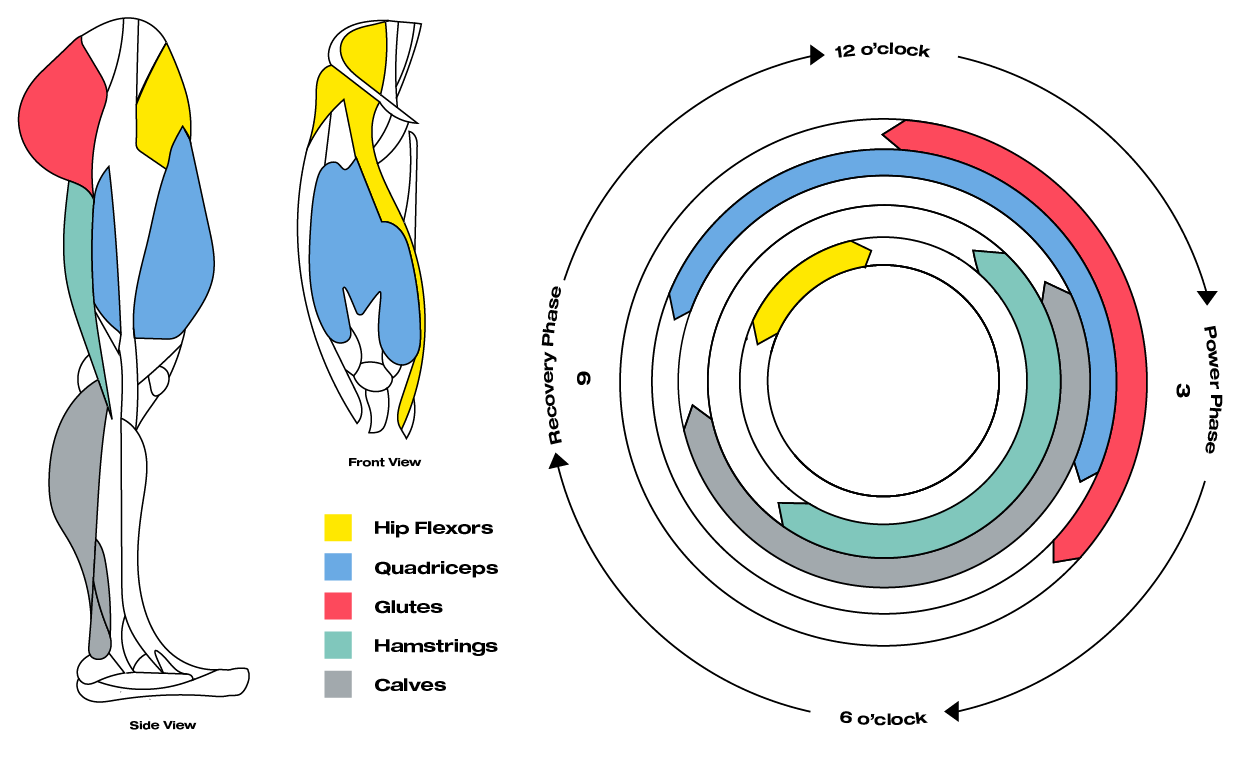
This is where it gets visual. If a robot pedalled, you'd see a perfect circle, even force applied throughout the stroke. Humans can't achieve this (and shouldn't try), but the shape you create tells a story about your muscle recruitment, timing, and efficiency. The quadriceps are the primary muscle group used to extend the knee and the hip during the downward pedal stroke. During the reverse motion, the hamstrings are the primary flexion muscle group activated between 6 and 12 o’clock of the pedal stroke to help bend the leg and bring the pedal back to the top. Due to the flexion muscles being weaker than the extension group of muscles, the optimum shape of the force curve would be similar to a sausage shape.
Below are some of the possible shapes you may see on the wattbike and what they represent:
PRO CYCLIST (ITALIAN STALLION):
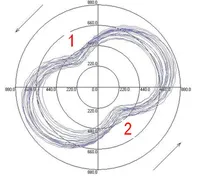
The Pro Cyclist Large, rounded, symmetrical. This rider activates their full muscle chain, quads pushing down, hamstrings and hip flexors pulling through and up. Power flows rather than punches. Minimal dead spots. Maximum efficiency. This is what we're building toward.
BABY PRO (MEXICAN CHIPOLATA):
This shape indicates a correct pedalling technique with all the correct muscles being activated, however, the rider is not completing a full revolution of the pedal during each stroke. This is demonstrated from a narrow shape being created and as a result of the rider not going to their full extremities with each pedal revolution, ie. they are not able to achieve their maximum power output.
ASPIRING CYCLIST :
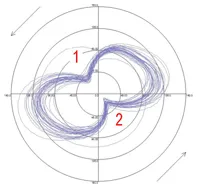
hat distinctive "peanut" shape reveals the issue: you're losing momentum between legs. You're pushing down effectively but not pulling through. It's an 80/20 split, quadriceps doing most of the work, hamstrings barely showing up. The good news? This responds quickly to focused technique work.
What it reveals:
- Inconsistent force application
- Lost watts at the top and back of stroke
Real-world symptoms: You feel “strong but slow.” You can work hard, but speed doesn’t match the effort.
THE STOMPER
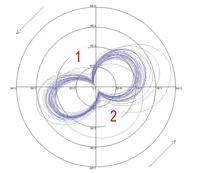
Pure downward force, massive dead spots at the top and bottom of the stroke. You're essentially doing single-leg presses alternately. This pattern burns through energy at an alarming rate and explains why you're exhausted while slower riders cruise past. The gap between your current state and an efficient stroke represents your biggest opportunity for improvement.
What it reveals:
- Leg dominance (usually right-side heavy)
- Poor engagement of hamstrings and glutes
Real-world symptoms: Burning quads. Sagging cadence. Paying for it on climbs
Why Your Pedal Technique Might Be Broken
In our pedal technique coaching sessions, we've identified the most common culprits:
- Old injuries compensating in new ways - Your body adapted to protect an old knee injury, and that compensation pattern is now your default, five years later
- Bike fit issues - Even 5mm in saddle height can fundamentally alter your stroke mechanics
- Cleat position - Misaligned cleats force your body into compensatory patterns
- Limited ankle mobility - Can't dorsiflex properly? You can't complete an efficient pedal stroke
- Core weakness - A stable platform is essential for generating and transferring power
- Simply never being taught - Most riders learned to pedal as kids and never revisited it
The complexity is why self-diagnosis rarely works. You can't feel what you can't see, and you can't fix what you don't understand.
The 20-Watt Question
Twenty watts doesn't sound like much. But let's put it in perspective: that's the difference between holding 250W and 270W on a long climb. For some riders, that's 3-4 months of structured training gain available immediately through better technique.
And here's the psychological edge: when you pedal efficiently, hard efforts feel more manageable. You're working with your body rather than against it. That mental shift from "I'm suffering" to "I'm flowing" changes how you approach challenges on the bike.
In other words: Better technique = More speed for less effort.
What an Njinga Pedal Technique Session Actually Involves
This isn't about us telling you to "pedal in circles" and sending you on your way. Our 60-minute pedal technique assessment is diagnostic and prescriptive:
- Baseline Force Curve Analysis - We capture your natural pedal stroke across different intensities
- Video Biomechanics Review - Sometimes the issue is visible before it shows up in the data
- Mobility and Strength Screening - We identify physical limitations affecting your stroke
- Real-Time Feedback and Drills - You see your force curve change as we make adjustments
- Personalised Action Plan - Specific drills, stretches, and cues to cement your new pattern
The session is immediately actionable. Cyclists regularly leave having made visible improvements in their force curve and having felt what efficient pedalling actually feels like. That kinaesthetic awareness, the "aha moment" is something you carry into every ride afterward.
What Riders Say After Their Sessions
"I am an experienced club cyclist so had pretty good pedal technique (so I was told) but the guys at Njinga have improved it further with a 50/50 distribution and more efficient pedal stroke." — Jed Harrison
"I can now proudly say that I have a proper pedal technique after years of "stomping", not to mention the fact that my fitness has improved dramatically and in a measurable way thanks to the FTP testing. The Wattbike is a fantastic fitness machine not only in terms of comfort but also the diagnostics so well worth learning how to use it properly." — Ivan Schofield
"I have just finished my 7-week Group Pedal Improver Training Programme with Njinga cycling under the tutorage of Togo the CEO and his team. What an eye-opener. I learnt about nutrition, specialist stretching for cycling, and how to pedal properly. They corrected my appalling riding technique, helped me pedal more evenly and what's more the buzz in the lab is fantastic. I'm hooked. I am now faster cycling to work, but more importantly, I find it easier. My wife and I really enjoy the hugely varied range of classes. You never get bored and it's such brilliant value. I am getting fitter and having fun at the same time. Age is no barrier, I should know. Thank you all at Njinga Cycling." — Chris Fowles
These aren't exceptional results, they're typical. Because when you address a fundamental inefficiency, the improvements cascade through everything else.
Ready To Stop Leaving Watts On The Table?
If you're training hard but not improving fast enough…
If your legs fatigue earlier than they should…
If you’ve ever wondered why your numbers don’t match your effort…
A pedal technique session is the fastest, most efficient way to unlock real performance gains.
Book your session here and experience what riding with true efficiency feels like.
Train Smart. Ride Strong. Live Fully.
Featured in Cycling Weekly, Rouleur & Cycling Plus