It’s All About the Base: The Simple Power of Zone 2 Training for Cyclists
Discover why Zone 2 training isn’t just "easy riding". It’s the hidden secret to building lasting endurance, stronger climbs, and smoother recovery. Unlock the simple science that turns steady rides into serious fitness gains and gives every cyclist a powerful, sustainable aerobic base.
If you want to build lasting cycling fitness without burning out, Zone 2 training is your foundation. It’s the critical building block of every strong cyclist, whether you’re preparing for an event, coming back from a break, or simply wanting to enjoy riding more.
In this guide, you’ll learn:
- What Zone 2 training is.
- How it works (in simple terms)
- Why it’s essential for cyclists over 40
- How to know if you’re actually in Zone 2
- Why riders often get Zone 2 wrong
- How much Zone 2 you really need
- Example sessions
- How long it takes to see results
This is the same structured, science-led approach we use at Njinga, designed to fit real life and help you train smarter, not harder.
What is Zone 2 Cycling Training?
Zone 2 is low to moderate effort. You’re working, but not struggling. You can talk in full sentences, your breathing is steady, and your legs feel smooth rather than heavy.
Numerically, Zone 2 sits at:
- 56–75 percent of your Functional Threshold Power (FTP)
- A steady low aerobic heart rate
Think of it as your natural endurance pace on the bike: comfortable, controlled and sustainable between active recovery and tempo zones.
The Science Behind Zone 2 (Made Simple)
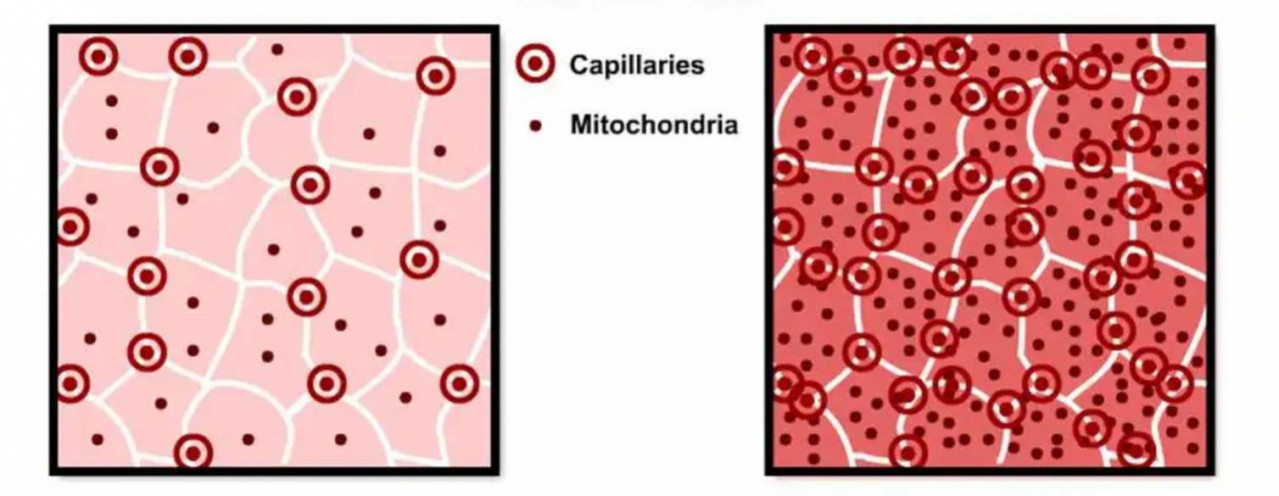
When you ride in Zone 2, your body relies mainly on aerobic metabolism, which uses oxygen to create energy. This activates your slow-twitch muscle fibres and improves the efficiency of the ‘motor’ or ‘power stations’ inside each your cells called mitochondria.
More mitochondria means:
Better energy production, Improved fat burning, Lower lactate build-up, Stronger endurance and
Faster recovery. Zone 2 isn’t flashy, but it creates long-term fitness that makes every other part of cycling easier. As a result, your body becomes more energy efficient and this has a massive positive knock on effects to your overall health. Think of moving from a diesel engine to a supercharged hybrid.
How Zone 2 Helps You Ride Better
Consistent Zone 2 training helps you:
- Ride longer without fatiguing
- Keep a lower heart rate at the same speed
- Use fat more efficiently as fuel
- Save glycogen (stored carbs in the muscles and liver) for harder efforts later
- Recover faster between tough interval sessions
- Stabilise power and cadence through neuromuscular efficiency
- Climb and hold steady power more confidently
These adaptations are why the base training phase for cyclists is essential. Without this foundation, riders often plateau, feel tired all the time or struggle to recover between intervals.
In the big picture of improving overall cycling performance, the goal is to stave off the accumulation of lactate that occurs when we ride at higher intensities. You may associate this as the point where you start to get that painful feeling in your legs from oxygen not being able to get to the muscles fast enough i.e. not long after working at threshold or above intensity (mid zone 4 / FTP score and above).
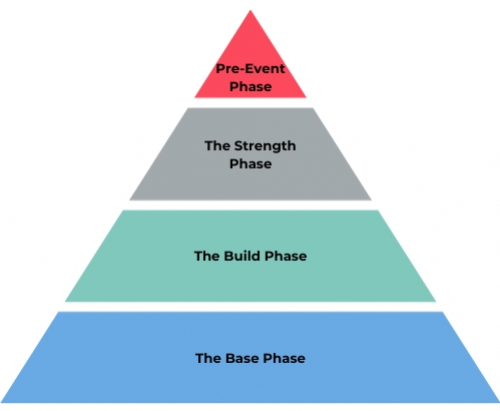
In order to achieve this ultimate goal, I need my riders to follow a prescribed zone 2 plan at the beginning of their periodised training plan (or for a large part of their polarised training plan) – The Base Phase. This plan stimulates mitochondrial growth and density to ultimately delay the onset of fatigue as the plan moves through the build, strength and pre-event phases.
These adaptations from all the training in Zone 2 allow my riders to become super efficient, recover faster from harder efforts later in the plan and train at higher volumes while lowering their chance of fatigue and injury.
How Do I Know I’m Actually in Zone 2?
This is the biggest challenge for most cyclists. You will know when your in the right place when you can :
- Talk in sentences and your breathing is steady and relaxed.
- You heart rate should rise slowly and stays stable and essentially you feel like you could keep going.
Indoor vs Outdoor
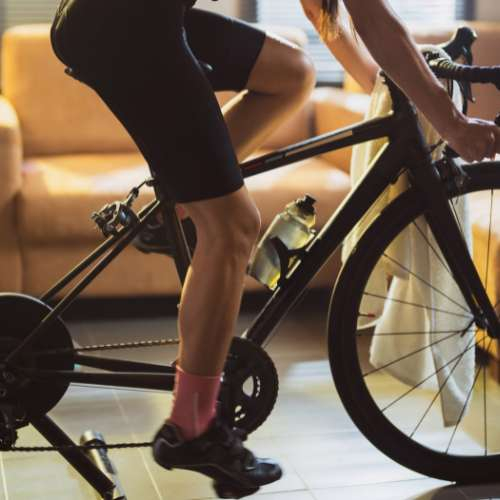
Zone 2 should feel gentle and sustainable, not like a fight that’s why I favour indoor training for this as it’s the most controlled environment. If you do plan to do it outdoors, watch gradients (uphill or downhill), group pace, and wind as they can push you out of Zone 2 quickly. Likewise avoid routes that have a lot of traffic or too much stop starting as this can create a lot of junk miles. Many commuting miles my riders make (to and from work) claim they are zone 2 training rides but most are actually junk miles especially those commuting into busy towns or populated areas.
Why Cyclists Often Fail at Zone 2 (And How to Fix It)
Even experienced cyclists get Zone 2 wrong. Common mistakes include:
1. Using outdated FTP values: Old training zones push riders out of Zone 2 without realising.
Fix: Re-test on average every 8–12 weeks
2. Drifting into higher zones on hills: Even small gradients can push power up.
Fix: Shift earlier, stay relaxed, avoid chasing speed.
3. Cycling by feel only: Zone 2 feels ‘too easy’, so riders push harder.
Fix: Train ideally with a power meter and heart rate. Trust your training zones and stay patient.
4. Under-fuelling: This raises heart rate and makes Zone 2 feel harder.
Fix: Fuel rides over 60 minutes.
5. Group rides or Strava segment hunters: Easy rides turn into accidental intervals.
Fix: Keep Zone 2 rides structured and separate from social rides.
Fix these and your Zone 2 training sessions will finally work as intended.
How Much Zone 2 Training Should You Do?
Given you’re not a professional cyclist who can dedicate months in the off-season to long daily hours in zone 2 then it all depends on the following:
- What your objective is?
- How far out you are from your cycling event?
- How much time can you dedicate to training a week?
The above will determine how much zone 2 training you can do depending on what your primary objectives are. (See recommendations below).
Training Recommendations Based on Objectives:
- Build a solid cycling fitness base and have time on your side in the build-up to your event – I’d recommend 45-60 minutes a day for a minimum of 8-12 weeks. I refer to this as the pyramid effect where the wider the base you build, the greater the potential to build the pyramid in a periodised training plan. This is the gold standard approach to any cycling training plan where a rider has an extended lead time to their event and can dedicate a minimum of 6-7 hours a week. If a rider can dedicate more time a week then I would add 1 to 2 longer sessions of 2-3 hours so ideally 9-13 hours a week. Weather permitting, I get riders to do at least 1-2 longer rides outdoors on their bike.
- Maintenance mode - If you want to maintain your cycling fitness and not lose some of the gains you have already made from an earlier training block, then I'd introduce 3-4 x 45-60 minute zone 2 sessions into a rider's training plan, with 1-2 tougher interval sessions in zone 4-5 for 30-45 minutes.
- Best Gains with only 3-4 hours to spare a week – If you are time-pressed I’d do 3 x 45 minutes and 1 x 90 minutes in zone 2 or 3 x 45 minutes and 2 x 60 minutes or 3 x 60 minutes and 1 x 90 minutes in zone 2.
- Coming back from injury or no event planned yet and you can dedicate 5 hours a week – I’d recommend 3 x 45 minutes, 1 x 60 minutes indoors, 1 x 2 hours outdoors in zone 2.
- Weight loss to improve power to weight - I’d introduce 4 x 60-minute fasted sessions in strictly zone 2 first thing in the morning and 2-3 x 45-minute sessions later in the day or after some food intake. You can also do elements of this later on in a periodised training plan. Please avoid fasting if you are highly stressed, little sleep the night before or women who are in the menopause phase.
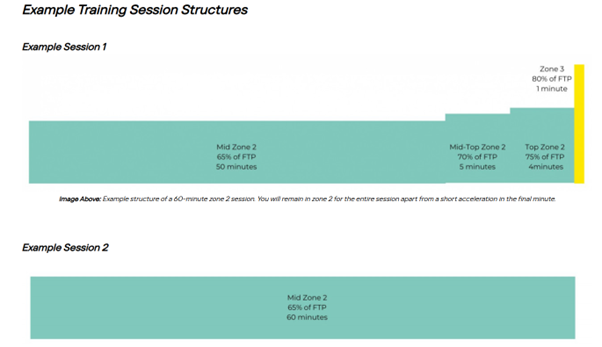
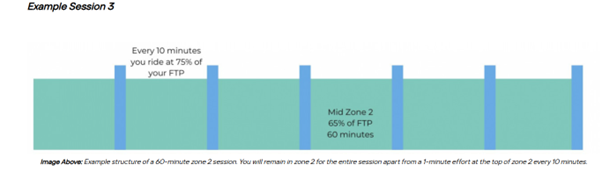
Example Zone 2 Sessions
How to Test for Your Zone 2 Training Zones
Before you even start a zone 2 training phase or a base training plan, you need to work out your training zones for your current fitness level. I recommend all the riders I train to either perform a 20-minute FTP test (or a Max RAMP test to exhaustion) ideally on an indoor bike or indoor trainer that projects power, cadence and speed to get their accurate zone 2 training zone.
Your FTP score is 95% of your 20-minute average power or 75% of your final Max RAMP power (if strict it will be your final minute completed). Once you know your FTP score then 56-75% of that is your zone 2 power. Your zone 2 heart rate training zone will be 68-83% of your threshold heart rate (average HR for the test).
Too often many cyclists don’t test and use old FTP training zones which are often inflated and as a result, riders often end up working outside zone 2 and having little or no proper zone 2 adaptation.
When I work with my 1-1 Elevate coaching clients, I ensure they prepare properly before a 20-minute FTP Test and use a heart rate (HR) monitor (preferably a chest strap for accuracy) as we want to see what their threshold HR is for the 20 minutes as well. This is essentially your average HR for the 20-minute FTP test only. This allows me to work out their heart rate training zones as well which is a super valuable metric to track alongside your power when doing zone 2 training.
How Long Until You See Results?
You won’t need to wait long to feel the benefits of Zone 2. Most riders notice easier breathing within two or three weeks, followed by a lower heart rate at the same power around the four to six-week mark. By six to eight weeks, endurance feels stronger and steadier, and by eight to twelve weeks many riders see real changes on the climbs and in their overall stamina. The first improvements are always the subtle ones: smoother breathing, better heart rate control and finishing rides feeling fresher rather than drained. The bigger shifts, FTP gains, climbing strength and changes in body composition are things that come later with patience and consistency. Zone 2 isn’t about heroics. It’s about showing up, giving your body time to adapt and letting the progress build week by week.
Coach Tips
- Try to do the shorter sessions (up to 60 minutes) indoors as the quality is magnified by not having to worry about everything around you like when on a ride out e.g. traffic lights, cars, potholes, etc. See an independent guide for the best-rated indoor trainers for every budget.
- The perfect time to start base phase training is in the winter months.
- When doing zone 2 training I recommend training to both power and heart rate to accurately measure how hard you are working and your body’s response. Therefore I recommend always wearing a heart rate monitor that uses Bluetooth or ANT+.
Zone 2 Cycling FAQs
Common Myths About Zone 2 Training:
1. “Zone 2 is too easy to matter.” - It creates the deepest aerobic adaptations.
2. “You need long rides only.” - 45–60 minutes is still effective.
3. “If I’m not tired, it didn’t work.” - You should finish feeling good.
4. “Zone 2 is only for beginners.” - Pros spend much of winter in Zone 2.
5. “More Zone 2 hours always mean more progress.” - Without structure, extra volume just adds fatigue.
Whether you're striving to enhance your endurance, improve fat adaptation, or increase your heart's efficiency, zone 2 training is a science-backed approach that can take your cycling performance to the next level.
How some of our riders have benefited from Zone 2 Training:

"Since starting Zone 2 training, I’ve been amazed at how my recovery has bettered between efforts. The Z2 training plan has helped my on-bike performance massively. Having recently re-ridden a route I completed a year ago in Spain, I bettered the time by 25 minutes…brilliant results." Luke King
"It took me a while to embrace, but now I love zone 2 training. No more endless cycles of pushing hard every day until I burn out physically and mentally and have to take a week or longer to recover. It's honestly transformed my training. My performance on the days I push hard has reached new levels and 30-60 minutes of zone 2 on my off days are a joy. They are amazing for my recovery and longer-term increased endurance." Monie Lindsey

"Since starting my training with Togo at Njinga Cycling in late 2021 riding indoors and out at Zone 2 has become an important part of my training routine. Houses have to be built on strong foundations and the same is true of cycling.” Miles Flint
"Zone 2 is at the heart of all my training and I do at least 3 hours a week. Its impact has been transformational, using longer blocks in the off-season to build a base on which I’ve seen big gains in FTP. Beyond building base, it’s really helped me manage my heart rate to become more efficient and I’m now using this to bring focus to better breathing." Simon Hathaway
A Supportive Next Step from Us
If you’d like help setting your training zones or building a structured base plan that fits your life, we’re here to guide you.
If you struggle to train on your own and want affordable expert coaching support in a group programme then try our Accelerate Group Cycling Coaching Programme. Block 2 starts Monday 8th December and is all focused on Zone 2 training.
Or, if you want something more personalised to your specific goals, check out Elevate 1-to-1 Cycling Coaching.
It’s All About the Base: The Simple Power of Zone 2 Training.
Featured in Cycling Weekly, Rouleur & Cycling Plus